 News
News
From the Arctic to the Capitol: An Alaskan Guide Speaks Up for the Refuge
November 18, 2025
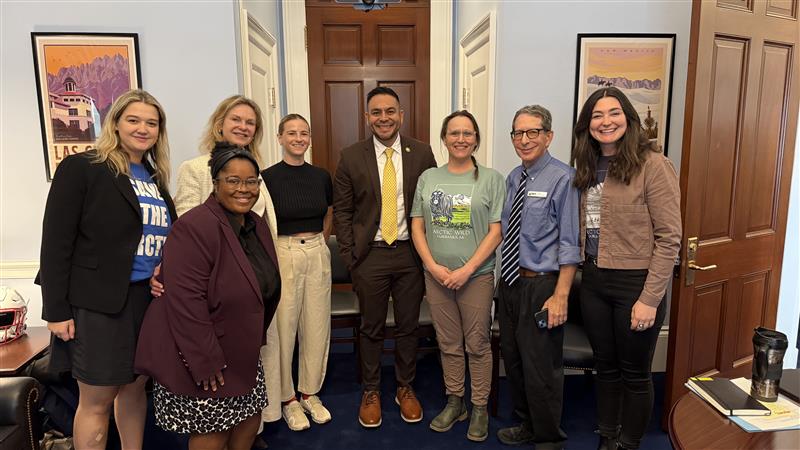
This past fall, Alaska Wilderness League invited Arctic Wild guide Emilie Entrikin to D.C. to advocate for the Arctic Refuge during Wilderness Week–an advocacy event hosted by the National Wilderness Coalition. Read more about her experience below.
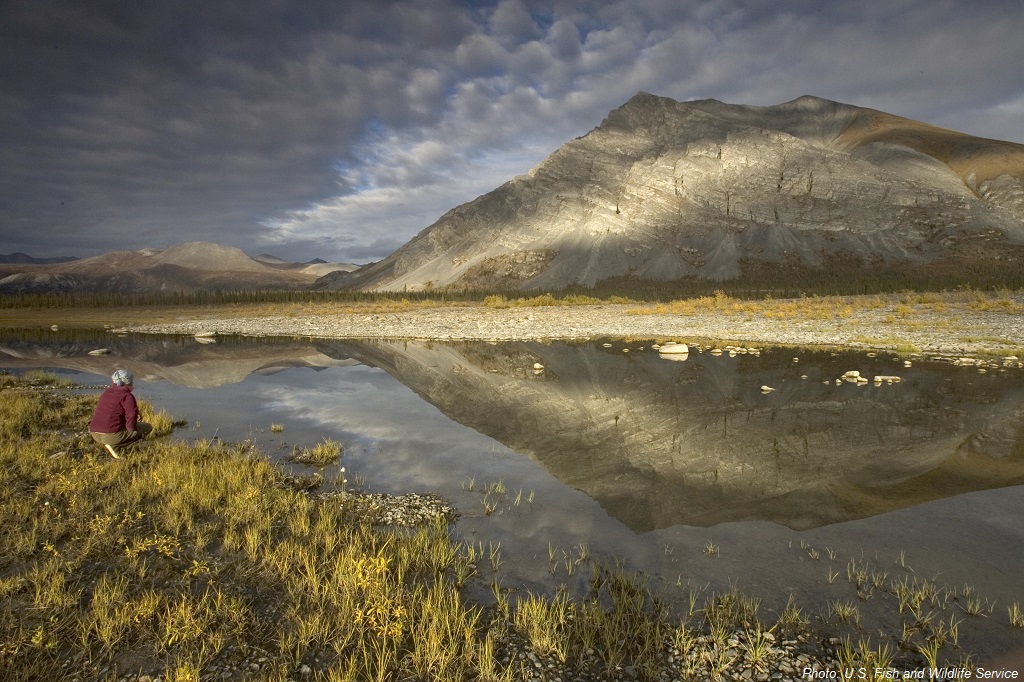
For 17 years, I’ve traveled through some of the most remote and spectacular corners of the Alaskan Arctic. I’ve floated the Canning, Aichillik, Hulahula, and Jago Rivers; walked the gravel beaches where seals haul out on shore-fast ice; and followed trails from the coastal plain into the Sadlerochit Mountains. Year after year, I’ve witnessed the Arctic Refuge’s short seasons shift—ice melting off in June, bursting with wildflowers and mosquitoes by July, painted in maroon and gold by August, and freezing again by early September.
I’ve seen millions of birds arrive from around the world to nest and raise their young. I’ve watched belugas cruise the shoreline, wolves chase down caribou, Arctic and red foxes play together on the tundra, and people harvest from the land. I’ve also seen the garbage left behind by past drilling—reminders of why this landscape cannot absorb industrial pressure.
This is why, when the Alaska Wilderness League invited me to Washington, D.C., I said yes. Partly because I was curious—what does policymaking actually look like up close?—and partly because I felt a responsibility to speak for a place many decision-makers will never see firsthand. I don’t always feel like the strongest public speaker, but I have spent significant time traveling through the Arctic Refuge and can share the truth: this place is not a “flat landscape with nothing there.” It’s rich and vital to the flourishing of Arctic ecosystems, and honestly, to the health of our planet.
I may never fully capture everything people should know about the Arctic Refuge, but I wish everyone could feel its depth, beauty, and importance—not only for global ecosystem health, but for the creatures who depend on it. I want people to feel that connection, to understand that we are part of this ecosystem, not separate from it.
The Refuge holds something essential we cannot recreate. It deserves our protection, our respect, and our voice. The Arctic National Wildlife Refuge is not just wilderness—it is a living testament to resilience, adaptation, and the interconnected web of life that sustains us all.

A Guide in the Halls of Congress
I’ll admit I was intimidated at first—by the concrete, the elevators, the fashionable clothing. But Alaska Wilderness League and the National Wilderness Coalition made the transition smooth, and once I figured out the nuances of operating elevators, everything went smoothly.
Between meetings with Congressional staff, I walked the memorials and free museums, and their strong emphasis on humanity and inclusion brought me a renewed sense of hope and love for our country.
We attended a subcommittee hearing on Alaska’s natural resource development, where Alaska’s small community shone through immediately: I recognized several other Alaskans who made the journey to D.C., even those on different sides of the issues. This made it clear: Alaskans who care about conservation need to keep showing up to ensure that our voices are heard by our representatives. We need to keep advocating for the interests of small businesses, like Arctic Wild, and for renewable natural resources, both in the energy sector and in the tourism industry.
In tourism, especially, conservation has real economic value. As I often say, borrowing the words of longtime Alaska business owner Ron Yarnell: “A tree has value standing up.” For tourism—the state’s second-largest economic engine—the natural world is the asset. It deserves equal footing in policy discussions.

Why Voices Like Ours Matter
Like many people, I’ve wondered whether individual voices really make a difference, especially with the current administration. But after spending time in D.C., meeting lawmakers, and seeing Alaska Wilderness League’s team just blocks from Capitol Hill, I left believing more strongly than ever that our voices matter. We need to continue putting pressure on lawmakers and voicing support for conservation and the protection of our natural resources for long-term use.
I came home with a clearer understanding of how decisions are made, and a deeper conviction that those of us who know and love this landscape must keep speaking up for it.

Emilie is a professional wilderness guide, safety coordinator, and conservation advocate based in Fairbanks, Alaska. Since 2008, she has led expeditions throughout Alaska, bringing superlative river skills from rafting glacial rivers in Southeast Alaska to paddling remote Arctic waterways. Her expertise in risk management and wilderness travel, combined with an easygoing, down-to-earth approach, has made her a trusted leader in Alaska’s outdoor community.
For the past 17 years, Emilie has worked extensively in the Arctic National Wildlife Refuge as a guide and safety coordinator, developing deep knowledge of the region’s ecology and the critical importance of protecting these wild landscapes. An accomplished musher, she has raced her sled dog team across Alaska, Canada, and the Lower 48. She lives in a small cabin in the hills outside Fairbanks overlooking the Chatanika River Valley, where she continues her work connecting people to Alaska’s wild places.